Beyond the API: Why Production AI Needs Execution Control
Most enterprise AI journeys begin with a deceptively simple question: Which is the latest, largest, smartest model we should use for this workflow? In a market where model releases move so quickly, the question often boils down to: what model is the flavour of the week?
That question made sense when most enterprise AI use cases were narrow: chatbots, document summarizers, copilots, or basic text generation. But as AI moves into production-grade workflows, the question starts to break down. A production AI system is rarely one prompt and one answer. At the application layer, the user may see one clean experience, but underneath, the system runs through retrieval, classification, routing, tool calls, document parsing, speech recognition, summarization, validation, guardrails, retries, and downstream actions before the task is complete.
The mistake is treating that chain like a set of API calls instead of an execution system, and that mistake shows up later as latency, failure rates, vendor dependence, and gross-margin leakage. It also changes the optimization problem: when AI was mostly a single model call, the main question was access — which model gives us the best answer? But when AI becomes a production workflow, the question shifts from access to execution, and teams have to ask how the full chain behaves: how many steps are running, where the data moves, which model handles which task, how much latency is added between stages, and what the full workflow actually costs to complete.
For simplicity, I use “open-source” broadly in this essay to include open-weight models where teams can inspect, host, adapt, or control the model artifact. Licensing and true openness vary significantly, and that distinction matters in production.
This is why the debate around open-source models is often framed too narrowly. Open-source models are not simply cheaper alternatives to closed APIs or just a hobbyist movement. Their real value shows up when production teams need control over where data moves, which model runs, how latency accumulates, how behavior is versioned, and what the workflow costs end to end.
Most importantly, open-source models give teams the possibility of owning execution, and once AI becomes part of a real production workflow, control over execution becomes control over margin, reliability, privacy, and long-term defensibility.
The real economic unit is cost per successful workflow
Cost per million tokens has become the default way teams compare AI pricing. It gives builders, product teams, and finance teams a common unit to compare providers, estimate usage, and understand model cost. For simple AI usage — a chat-based interaction, a generated response, or an individual using AI to speed up their own work — that unit is useful enough.
The headline cost per token has moved sharply in the right direction. Frontier models that once cost tens of dollars per million tokens now have cheaper comparable tiers. Mid-range and lightweight models have become dramatically more affordable. Open-source and open-provider competition has pushed prices down even further.
So the simple story seems obvious: tokens are getting cheaper. But for production-grade software, cost per token is only part of the picture, because the real economic unit is cost per successful workflow.
The buyer is not really buying tokens or model access. They are hiring the AI system to complete a job: resolve the ticket, process the document, review the claim, fix the code, reconcile the invoice, or complete the workflow. The user sees one final answer, but the company pays for every hidden internal step that produced it.
The volume shift
We are moving from a world where one prompt produced one response to a world where production workflows involve retrieval, reasoning, validation, retries, tool use, and downstream actions. As AI systems become more agentic, token consumption per task can rise fast enough to overwhelm the unit-price reductions visible on provider pricing pages.
| Workflow type | Earlier AI pattern | Modern AI workflow pattern | Token consumption shift | Margin implication |
|---|---|---|---|---|
| Customer support ticket | Summarize history and draft response | Query CRM, retrieve policy, verify logs, draft, validate, retry | 10–20× higher token volume | Cheaper tokens may help, but hidden workflow calls still need cost control |
| Document / analytics workflow | Query a few vector chunks | Process larger files, tables, retrieved context, multi-step reasoning | 20×+ higher token volume | Unit cost can stay flat only if retrieval, routing, and validation are optimized |
| Software engineering agent | Review snippet and suggest fix | Read repo context, run tests, debug, patch, review, self-correct | 100×+ higher token volume | Token price drops can be overwhelmed by agent-loop consumption |
These are directional estimates, and the exact multiplier varies by workflow, but the pattern matters: production workflows consume tokens differently from simple prompt-response interactions.
Reasoning models make this even more important. With reasoning-heavy models, the cost is not limited to the visible answer returned to the user. Some providers bill hidden reasoning tokens as output tokens, even though those tokens are not visible in the final response. A user may ask for a short answer, but the system may spend many more tokens planning, reasoning, checking, and correcting before the first visible word is written.
There is also a second-order cost problem: errors compound across the workflow. If an upstream routing or extraction step fails, the downstream system may still spend tokens on retrieval, reasoning, validation, and response generation before the workflow eventually fails. In that case, poor accuracy is not only a quality problem. It is a margin problem.
The margin trap
The margin trap appears when that expanded workflow is billed through premium external APIs at every stage. Once AI becomes part of the product experience, inference is no longer just an R&D expense; it becomes part of cost of goods sold. A product may look healthy when the prototype maps one customer action to one model call, but the economics change when production usage depends on multiple premium calls, retries, guardrails, and validation steps behind the scenes.
For any company putting AI into core workflows, this is not just an infrastructure bill but a business-model risk. Scale can increase revenue while quietly damaging gross margin, because the customer still sees one feature while the company absorbs the cost of every operation required to complete it.
The open-model lever
This is where open-model economics matter. MIT Sloan summarized research showing that closed models cost users about six times as much as open ones on average. Even if the exact numbers vary by workload, provider, and deployment pattern, the cost difference is large enough that model choice becomes a margin decision once usage scales.
Open-source is not automatically cheaper. It becomes economically powerful when the workload is stable, recurring, and important enough to optimize. With closed APIs, much of the cost structure remains external, variable, and provider-controlled, while the upside from optimization is often bounded by the provider’s pricing model.
With open-model infrastructure, the company gets more levers: model size, batching, caching, custom routing, deployment location, GPU utilization, scheduling, model placement, and workload design. If a workflow runs thousands or millions of times, even small improvements across those levers can matter.
The caveat is utilization. Closed APIs are multi-tenant and pay-as-you-go, so if usage is low, unpredictable, or highly spiky, a closed API may remain the rational choice. A poorly utilized self-hosted deployment can be more expensive than a closed API. The point is not to replace every API bill with internal infrastructure. Ownership only changes the business model in specific workflows: high-volume, recurring, sensitive, latency-critical, or margin-critical tasks where controlling the execution path can protect unit economics over time.
Model choice is now portfolio optimization
A few years ago, the case for closed models was straightforward: they were simply better. That is no longer universally true. The best closed frontier models still lead in many of the hardest tasks: complex reasoning, advanced coding, long-horizon planning, difficult multimodal work, and general-purpose intelligence. But the gap is no longer large enough to make closed models the default choice for every workflow step, especially when cost, latency, privacy, and deployment constraints matter.
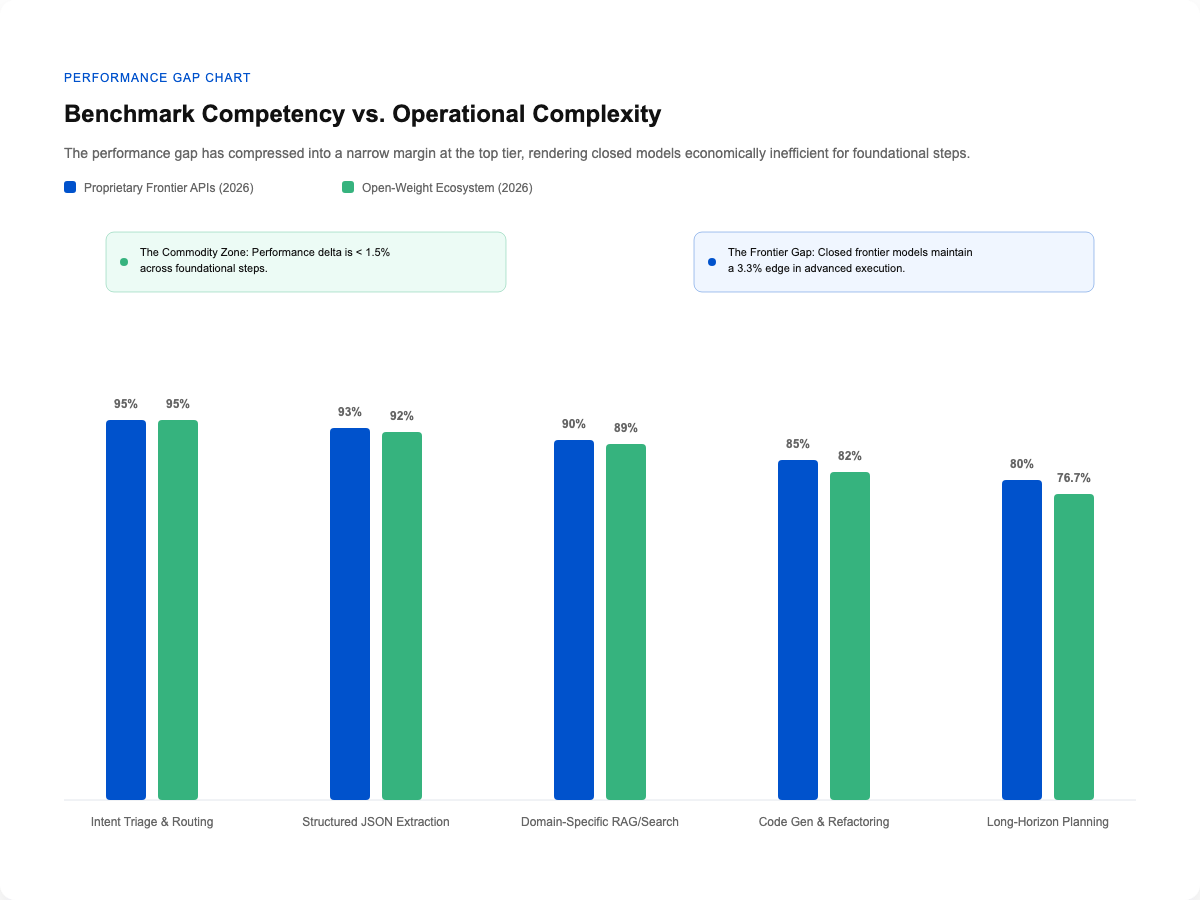
Source: Stanford AI Index 2026 technical performance section. Treat as benchmark context, not a universal measure of all tasks.
Production AI needs right-sized intelligence. Many workflow steps do not need the smartest model in the world; they need a model that is reliable enough, affordable enough, fast enough, and deployable inside the required environment. Intent classification, field extraction, request routing, transcription, reranking, JSON formatting, and safety validation are all important, but they do not all require frontier-level reasoning.
Using a large frontier model for all of this is like asking a specialist doctor to sort mail, update spreadsheets, and stamp envelopes: it may work, but it is an expensive use of intelligence. The one-model-for-everything strategy does not survive production economics, and a mature AI stack does not choose between open and closed models; it routes work across a portfolio.
The economics of routing
The pricing gap between model tiers remains enormous even as the capability gap narrows, which means that when token volume scales, model choice becomes a lever for margin.
High-volume inference should not automatically run on the most expensive model. Premium reasoning workflows may justify a more capable closed model. The most expensive frontier model should be reserved for the places where its incremental capability clearly produces enough business value to justify the token premium.
An indicative monthly comparison makes the point clear: for a workload consuming 1B input tokens and 1B output tokens per month, the difference between model choices can be dramatic:
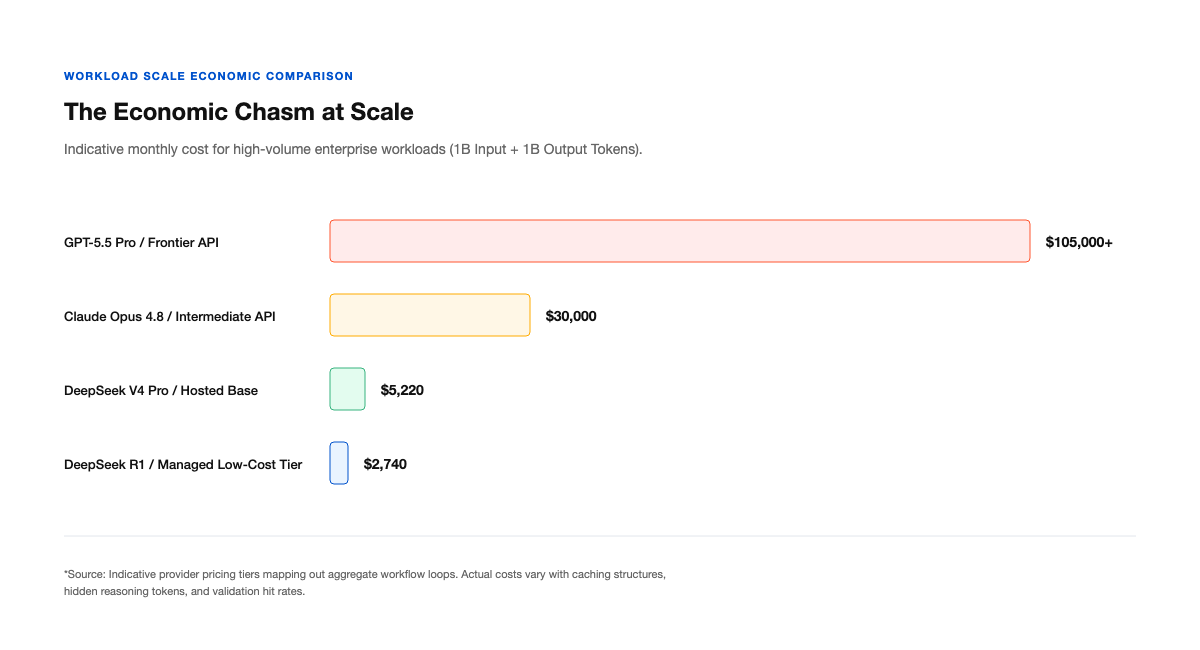
| Model tier | Indicative monthly cost for 1B input + 1B output tokens | Best usage |
|---|---|---|
| Premium frontier | ~$105,000+ | Complex reasoning, high-stakes synthesis, or tasks where incremental quality clearly justifies the premium |
| Premium reasoning | ~$30,000 | Reliable agentic workflows, nuanced reasoning, and premium workflow steps |
| Advanced low-cost / open-provider | ~$5,220 | High-volume inference where task fit is proven |
| Cost-optimized reasoning | ~$2,740 | Routine, high-volume classification, extraction, or cost-sensitive reasoning |
The exact numbers will move with pricing, caching, provider discounts, and model updates, but the strategic point remains: once token volume scales, model governance becomes a margin decision. At scale, model choice becomes routing policy — the right task, the right model, the right environment, and the right cost.
The abundance problem
“A wealth of information creates a poverty of attention.”
— Herbert A. Simon
The open ecosystem has shifted from a research playground into a large repository of task-specific components. Hugging Face alone lists more than 2 million models, organized across task categories with models, datasets, demos, and use cases.
This depth is useful, but it does not automatically create strategy. Once teams have access to dozens of possible models, the hard question is no longer whether capable models exist; it is how to choose, test, govern, and replace them without turning the AI stack into a mess of disconnected experiments.
Open models do not need to beat the best closed model on every benchmark. They need to be strong enough for the workflow step they are responsible for.
The right question is no longer whether this is the best model overall; it is whether this is the right model for this task, at this cost, latency, privacy, and deployment profile.
Because the workflow is modular, teams can improve it over time. If a newer model with a similar footprint performs better for one step after proper use-case testing, that specific model can be replaced without rethinking the entire application. It is closer to upgrading one component in a system than replacing the whole machine.
The routing layer
A production-grade AI stack should route work based on task type, privacy requirement, expected quality gain, latency budget, and cost profile.
| Operational stage | Model allocation | Strategic driver |
|---|---|---|
| Triage and policy | Lightweight open model | Low cost, local control, fast routing |
| Routine execution | Specialist or domain-adapted model | Stable cost, speed, workflow fit |
| Complex anomalies | Frontier API | Premium reasoning only where it changes the outcome |
| Validation and guardrails | Local audit / safety model | Stability, compliance logging, and workflow closure |
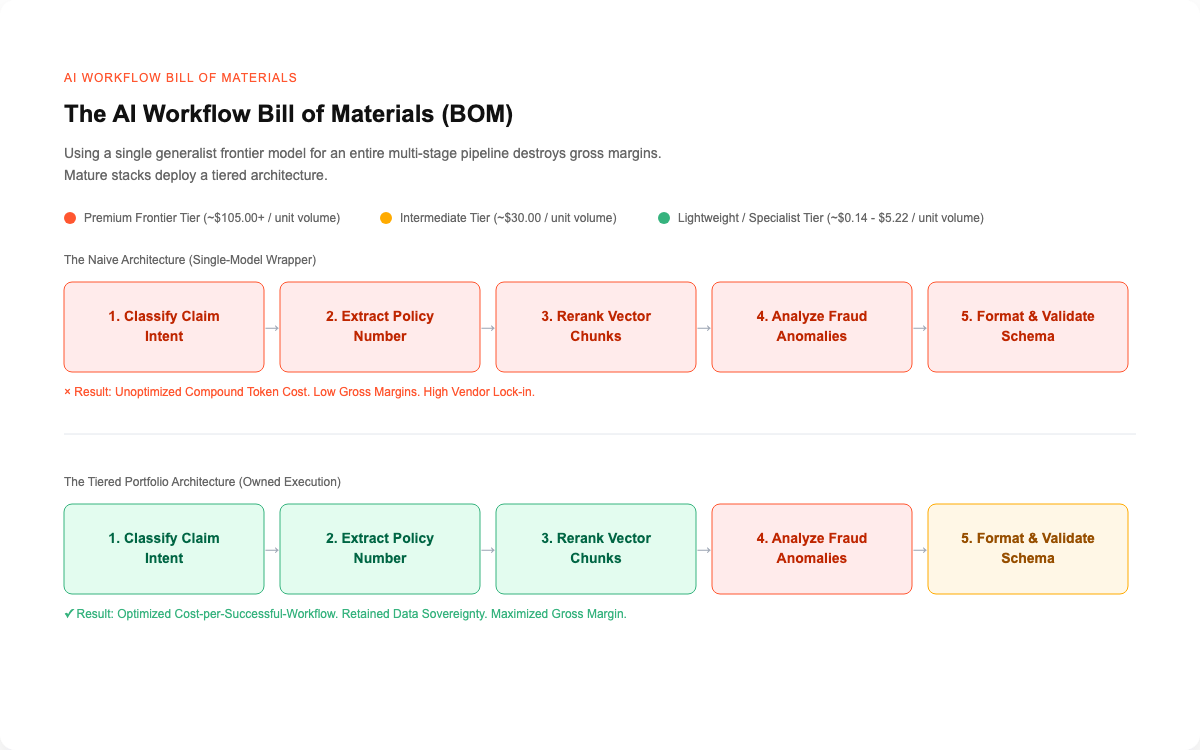
Many production workflows need one or two high-reasoning steps, surrounded by many cheaper specialist steps, but there is a catch: a multi-model portfolio introduces a complexity overhead. Every model call can add network overhead, queueing delay, cold-start behavior, and inference time, so the portfolio approach only works well when it is paired with intelligent orchestration: concurrent execution where possible, local caching, batching, model placement, and routing that avoids unnecessary hops.
For example, an automated insurance claims pipeline does not need a frontier model to extract a policy number from a PDF or categorize an incoming email. Those routine, high-volume steps can be routed to compact, specialized models running on controlled infrastructure. The system can reserve expensive frontier reasoning for genuine outliers that require deep analysis, judgment, or ambiguity resolution.
The advantage is not the model list; it is the routing logic that decides what runs where, when, and why.
Control matters when AI becomes infrastructure
There is a fundamental difference between shipping AI as a feature and operating AI as infrastructure. When AI is just a feature, speed usually matters most: you choose a strong API, build the prototype, validate the use case, and move quickly, because at that stage the underlying implementation may not matter much and the goal is to prove that the experience works.
But once that feature becomes part of a core enterprise workflow, the rules change. The system now needs predictable latency, reliable uptime, stable behavior, controlled data movement, auditability, security review, and clear operational boundaries. What looked like a simple product decision during the pilot becomes an infrastructure decision in production.
The compliance boundary
In enterprise environments, especially in sectors like finance, healthcare, government, telecom, and manufacturing, a workflow that cannot satisfy the customer’s data boundary is not production-ready. It may demo well, but it will stall in security review.
If sensitive customer data has to move through an external model endpoint, that may be acceptable for some use cases. For others, it becomes a blocker. Enterprise cloud providers have improved private connectivity, logging controls, and data-handling options substantially, including VPC-style implementation patterns and private deployment options, but those controls vary by provider, contract, region, model, and customer tier.
Open models remain attractive when teams need more direct control over where inference runs: inside a customer VPC, private cloud, on-prem environment, secured edge setup, or sovereign infrastructure boundary where the enterprise controls the inference path directly.
That changes the commercial conversation: the buyer is no longer being asked to adapt their data policy to your model provider, because the AI system can be adapted to their infrastructure and compliance requirements.
The operational contract
Control also matters after the system is live. Closed-model providers improve their systems constantly, and many of those improvements are useful — better reasoning, better safety, better speed, and better context windows all help the ecosystem — but in production, unexpected behavior changes can create risk.
A model update, safety-policy change, latency shift, pricing change, rate-limit change, or API behavior change can affect a live workflow. To a model provider, that may be an upgrade. To an enterprise running an automated process, it may be a regression.
Open models give teams more control over the release cycle: they can freeze a model version, test changes against their own evaluation set, run regression checks, and decide when to upgrade. That predictability matters when AI is embedded inside operational workflows, because in production AI, predictability can matter as much as raw intelligence.
That is why the production question is not only whether a model is capable. The better question is whether the workflow can run where it needs to run, behave predictably, meet the latency target, satisfy security requirements, and support the economics of the business.
At that point, execution control is no longer just an engineering preference. It becomes part of the product promise: where the workflow runs, how it behaves, what it costs, and whether the enterprise can trust it in production.
Domain-specific AI creates defensibility
Frontier models are trained to be broadly useful, while enterprise workflows are narrow, messy, private, and full of operational edge cases.
A workflow may involve insurance claims, loan underwriting, medical records, procurement documents, factory inspections, support tickets, recruiting pipelines, compliance reviews, or supply chain exceptions. The language is domain-specific, the data is private, the process is company-specific, the output format may need to be strict, edge cases are operational, and evaluation criteria may be internal.
A general-purpose model can be highly capable and still behave like an outsider inside a specific workflow. It may understand the language, but it may not understand the operating judgment: which exception matters, which field cannot be wrong, which answer will fail review, which edge case breaks the process, and what “good” actually means inside that business.
That is where open models can create more than cost advantage: they can create technical depth. But defensibility does not come from deploying an open model, because a downloaded model weight is not a moat. The foundation of defensibility, where it exists, comes from the layer the company builds around it: curated examples, evaluation benchmarks, retrieval pipelines, fine-tuning workflows, deployment architecture, operational feedback loops, and workflow-specific inference systems.
Proprietary failure data is the asset
Most teams want to jump straight to fine-tuning, but that is usually a mistake. Fine-tuning without a serious evaluation harness is not engineering; it is gambling.
If the data is too small, noisy, biased, or poorly representative of production reality, fine-tuning can make the model worse, not better. It can overfit to examples that do not reflect real usage, hide failure modes, or create false confidence because the team has no reliable way to measure improvement.
The first serious step is to define the task, collect representative examples, map failure modes, improve retrieval, and measure whether the system is actually getting better. Without that discipline, model selection is just opinion dressed up as engineering.
The evaluation harness is not the moat by itself. For serious teams, it is the cost of entry. The more defensible asset is the proprietary failure data behind it: the edge cases, acceptance criteria, rejected outputs, escalation patterns, and operational judgment that competitors cannot easily observe.
This is where unit-economic defensibility begins. Each real failure teaches the system how to avoid future waste, reduce rework, improve routing, and lower the cost of completing the workflow. Model weights will keep improving and new open releases will keep arriving, but a high-quality failure dataset tied to a real business process becomes proprietary knowledge.
The real asset is not just data; it is captured operational judgment, recorded through where the workflow fails, which failures matter, which errors are acceptable, which ones are business-critical, and how the system should behave when reality does not match the happy path.
Fine-tuning as a surgical tool
Fine-tuning becomes valuable only when the workflow is repeatable, the quality gap is measurable, and the company has enough high-quality examples to teach the model something the base model does not already handle well. Used badly, fine-tuning is expensive guesswork; used well, it is a surgical tool.
A China Mobile study showed this pattern clearly: a domain-tuned Qwen1.5-7B model reportedly outperformed both its base model and a much larger 72B general model on a bounded operation-and-maintenance task.
The lesson is not that smaller models are inherently better than larger models. The lesson is narrower and more useful: when the workflow is bounded, the data is relevant, and the evaluation target is clear, a smaller domain-adapted model can outperform a larger general model on that specific workflow.
A company that only wraps a third-party model may still create value through product, distribution, UX, workflow design, and customer data, but if the intelligence layer is entirely rented, the company has fewer levers to build technical depth in the execution layer.
Fine-tuned models, evaluation datasets, retrieval systems, deployment architecture, and workflow-specific optimizations can become part of the company’s technical IP. The more of the intelligence and execution layer a company owns, the more room it has to build defensibility beyond a thin API wrapper.
In production AI, defensibility does not come from having the smartest model in the abstract; it comes from building a system that understands the workflow better than a general-purpose model ever could by default.
The hidden tax of ownership
Open-source AI does not remove complexity, it reallocates it, and that reallocation is a business decision, not just an engineering decision.
When a team moves from a managed API to its own infrastructure, it is no longer just consuming a model endpoint. It is taking responsibility for more of the system lifecycle: capacity planning, serving stacks, hardware cost, reliability, observability, versioning, upgrades, security, and performance under real production load.
That is not a reason to avoid open models; it is a reason to be clear-eyed about what ownership actually means. Owning the model artifact is not the same as owning an AI stack, because a team may have the weights but still has to build the machine that makes those weights useful in production. The work does not disappear; it moves from API integration to systems engineering.
That shift has a real cost. Execution control requires engineering talent, platform maturity, observability, evaluation discipline, security review, and operational ownership. If a team has to hire ML platform engineers, SRE capacity, or dedicated LLMOps talent just to run the system, the savings may not be savings at all; the cost may simply move from vendor invoices to payroll, infrastructure, and operational risk.
This is why ownership should be treated as capital allocation, with the business choosing where to pay: variable vendor spend, internal engineering capacity, dedicated infrastructure, or some deliberate mix of all three.
The threshold for ownership is workload maturity. If usage is low, spiky, experimental, or not strategically important, a managed API may remain the better choice. Execution control becomes worth the cost when the workflow is high-volume, recurring, sensitive, latency-critical, margin-critical, or central to the business model.
For many companies, the right answer is not full ownership but selective ownership: keep managed APIs where speed and flexibility matter, and own the parts of the execution path where cost, privacy, latency, reliability, or customer requirements make control worth the burden. Open models can create leverage only when the organization can absorb the operational burden and turn it into execution control; otherwise, model ownership becomes a new cost center, not a strategic advantage.
The execution failure modes
A simple prototype may use one general-purpose API endpoint, but a production enterprise workflow behaves more like a multi-stage assembly line across classification, extraction, retrieval, reranking, reasoning, formatting, validation, and guardrails. The moment a workflow chains multiple models with dependencies between them, the failure surface area expands, and the team is no longer debugging one model output; it is debugging a distributed system.
A multi-model open-source workflow can improve economics only if the execution layer is engineered well. Otherwise, it simply replaces API bills with GPU waste, latency, and operational headcount.
| Failure mode | Operational failure | Margin / risk impact |
|---|---|---|
| Output drift | A model returns a structure, tone, or format downstream systems do not expect | Pipelines fail, manual review increases, and cost per completed workflow rises |
| Routing failure | A classifier sends the request to the wrong model, tool, or reasoning path | Cheap tasks may hit premium models, or expensive reasoning may be wasted on the wrong path |
| Hallucinated fields | Generated values pass through weak validation checks | Bad data enters business systems, creating rework, compliance risk, and downstream cost |
| Latency creep | Smaller models save token cost but add queueing, network, serialization, or handoff delays | The workflow becomes too slow, reducing automation value and user trust |
| Utilization sink | Models sit on reserved GPUs without enough batched traffic | Fixed infrastructure spend overwhelms the expected API savings |
| Regression blind spot | A model or prompt update improves one case but breaks another | Teams lose confidence, slow rollout, and add more manual QA burden |
This is the complexity overhead of multi-model AI: non-deterministic outputs, schema assumptions, routing mistakes, network hops, queueing delay, cold-start behavior, serialization cost, and inference time can quietly erode the advantage of using smaller or cheaper models.
Success depends on intelligent execution: integration tests, evaluation harnesses, standardized schemas, observability, fallback paths, batching, model placement, workload scheduling, and routing logic that treats the workflow as one optimized path, not a loose chain of isolated hops.
The GPU utilization trap
There is a dangerous economic fallacy in open-source AI: the model is free, so inference must be cheap. That is false, because the model may be free, but the GPU is not.
Closed APIs are multi-tenant and pay-as-you-go. If an application has no traffic at 3:00 AM, the model bill may be close to zero. If a team hosts models on dedicated GPUs, the cloud bill may continue whether the hardware is processing millions of tokens or sitting idle.
An idle GPU is not infrastructure; it is capital burning quietly.
Open-model economics depend on utilization. If traffic is volatile, workloads are poorly batched, or models sit isolated across underused hardware, the promised savings can disappear quickly. At that point, the company is taking on cloud-provider-like responsibilities without always having cloud-provider-level tooling.
The economics improve when teams can keep hardware busy through batching, scheduling, routing, multiplexing, and smart model placement. Without that discipline, open infrastructure can become just another expensive dependency.
Ownership only becomes advantage when the system can be operated better than the rented alternative. If a team cannot manage the orchestration, it has not built a moat; it has built an operational liability.
The real shift: from model access to execution control
The debate was never simply open versus closed; it was always about who controls the execution path once AI moves into production.
For pilots, access-first AI worked. Get the strongest model, connect the API, ship the demo, and pay the token bill. But production changes the stakes. If an AI strategy begins and ends with “which frontier API should we call?”, the team is not designing a system. It is outsourcing the economics, latency, reliability, and control path of the workflow.
That does not mean every team should self-host, fine-tune, or own the full stack. For many workloads, managed APIs are still the right answer. The question is not whether to rent or own everything. The question is where ownership becomes worth the operational cost.
The bottleneck is no longer access to a smart model; it is running a complete operational system reliably, privately, and profitably at scale. That requires a different mindset: API-first teams consume intelligence, while execution-first teams manage it. They route instead of defaulting, evaluate instead of guessing, optimize instead of consuming, and decide what to rent, what to own, and where control matters because economics, privacy, reliability, or customer requirements depend on it.
This is not about free software or engineering ideology; it is about building AI systems whose economics do not collapse when usage scales, whose behavior can be tested before rollout, and whose data path can survive enterprise review.
In AI-native products, unit economics will increasingly depend on how intelligently the system uses intelligence.
The era of model access is not over, but access is no longer enough. The advantage belongs to teams that know what to rent, what to own, and where execution control is worth the cost.
Source notes
Token price compression
The pricing comparison used in this essay is indicative and should be checked against current provider pricing. Model capability, context length, caching, batch pricing, reasoning behavior, and output quality vary across tiers.
Open vs closed performance gap
Stanford AI Index 2026 technical performance section reports that, as of March 2026, the top closed model led the top open model by 3.3% on Arena-style evaluation, up from 0.5% in August 2024. It also notes that six of the top ten Arena models were closed.
Source:
https://hai.stanford.edu/ai-index/2026-ai-index-report/technical-performance
Open-model economics
MIT Sloan summarized research showing that open models can cost 87% less to run for inference, while achieving roughly 90% of closed-model performance at release. The same article reported that closed models cost users about six times as much as open ones on average.
Hugging Face model ecosystem
Hugging Face states that its Hub hosts more than 2 million models, more than 1.5 million datasets, and more than 1.5 million AI apps/spaces.
Sources:
https://huggingface.co/docs/hub/en/index
https://huggingface.co/
Domain-specific fine-tuning example
A study using China Mobile operation-and-maintenance documents fine-tuned Qwen1.5-7B-Chat on 4,000 domain documents. The researchers reported a 174% higher performance score versus the base 7B model, a 22% gain over Qwen1.5-72B-Chat on that specific domain task, and an 18.6% average efficiency improvement over 117 days of deployment.
Source:
https://arxiv.org/abs/2408.12247
Open-source vs open-weight caveat
The term “open-source AI” is often used loosely. Many models are better described as open-weight rather than fully open-source because training data, training code, licenses, and usage freedoms may vary.
Useful background:
https://www.reuters.com/legal/legalindustry/legal-primer-open-genai-models-2024-08-15/
Hidden reasoning tokens
Some reasoning-model providers bill internal reasoning tokens as output tokens, even when those tokens are not visible in the final response. This matters because visible answer length may not reflect actual cost.
Source:
https://developers.openai.com/api/docs/guides/reasoning
Herbert Simon quote
Herbert A. Simon is widely cited for the line: “A wealth of information creates a poverty of attention.”
Useful background:
https://en.wikipedia.org/wiki/Attention_economy